RECON: A benchmark for researching individuals

By HUD Team, Sixtyfour Team
RECON is Sixtyfour's benchmark for researching individuals, the work behind due diligence, fraud investigations, and data enrichment. An agent gets a name and a few identifying details and has to find specific facts about that person, like a first employer, an old username or a company's original tagline, without mixing them up with someone else of the same name.
We ran 22 systems on it on HUD. When a system did answer, it was usually correct: precision ranged from 55.7% to 85.9%. The bigger difference was how many facts each system found, with recall ranging from 7.6% to 84.4%. In three selected traces, the system that missed had a real lead and stopped before reading the page that held the answer. The full results are on Sixtyfour's RECON page.
How we ran it
The dataset has 514 facts about 140 people across 14 occupational sectors and 16 countries, each checked against a public or archived source. We used Sixtyfour's dataset and evaluation code, with each model's own web search and tools where supported, between September 8 and October 6, 2026.
gpt-4.1-mini grades each answer as correct, wrong, or missing. Two reviewers checked 200 of its judgments without seeing which system answered, and it matched them on 197 (98.5%).
Weighted accuracy is correct answers minus wrong answers, divided by all requested fields. A blank costs nothing and a wrong answer costs a point, so a guess only pays if it's more likely right than wrong. Precision is the share of given answers that are right. Recall is the share of all facts found.
Sixtyfour built RECON and offers five of the systems we ran (XHigh, High, Medium, Low and Scout), and it kept RECON's people out of its own development.
Results
Sixtyfour XHigh ranked first at 70.6% weighted accuracy and High second at 54.3%. The strongest system from another provider was Parallel Ultra 2x at 41.1%. Resampling the 140 people puts XHigh's lead over High at 8.4 to 24.3 points and over Parallel Ultra 2x at 21.5 to 37.8 points (95% intervals).
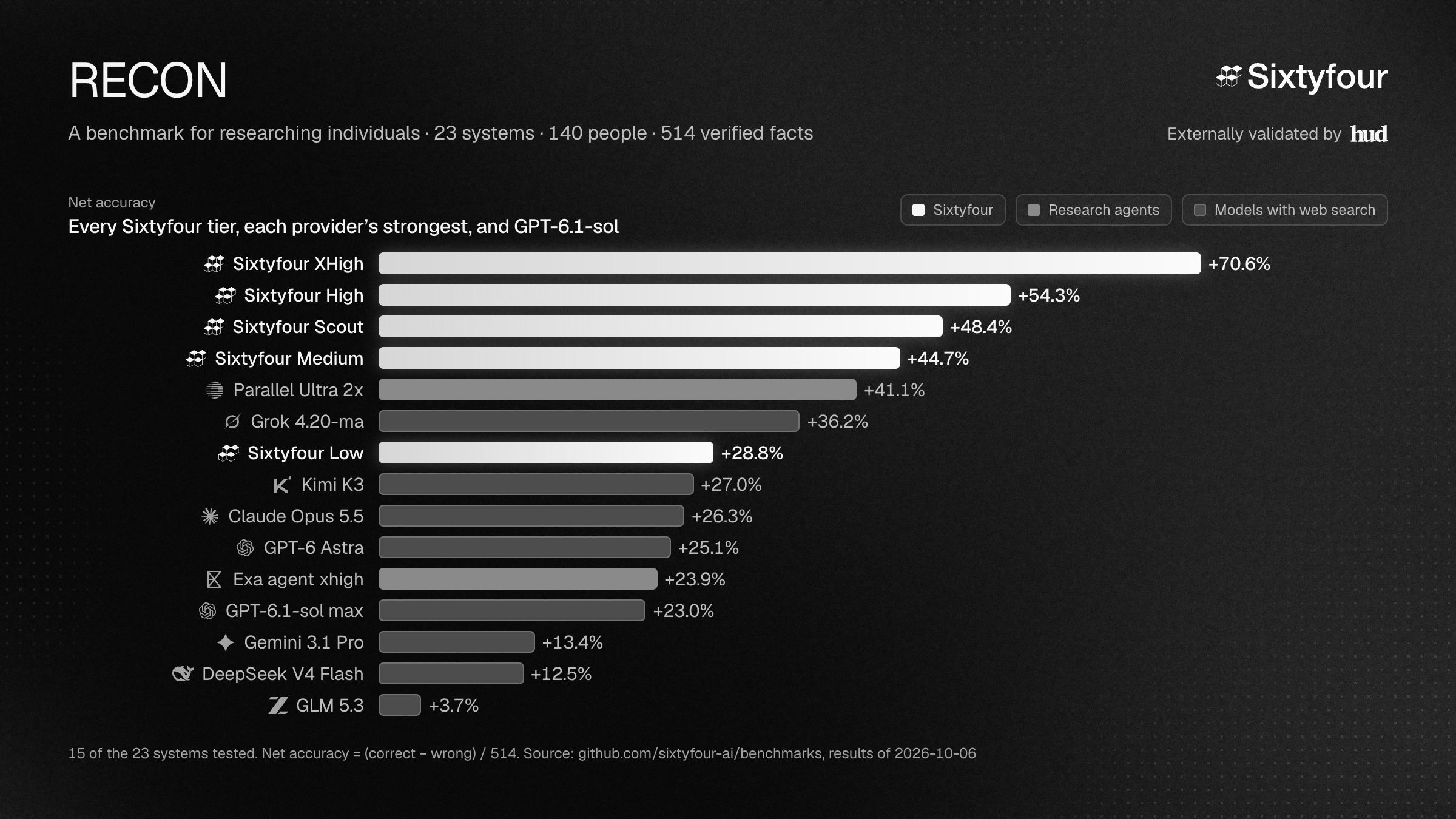
The gap is recall. XHigh found 84.4% of the facts, High 67.7%, at almost the same precision (85.9% vs 83.5%). XHigh left 9 fields blank where High left 97, with nearly the same number of wrong answers (71 vs 69). GPT-6.1-sol shows the other side: 85.1% precision, but it found only 27.8% of the facts and scored 23.0%.
What the traces show
Four selected cases, each comparing XHigh with GPT-6.1-sol. Names and identifying details are left out.
- A 1985 book. The question asked which book an architect's illustrations appeared in. GPT-6.1-sol ran 55 searches, ending with the book's title and her maiden name, and never opened a page. XHigh found an archived copy of her firm's publications page and searched the scanned book, where the captions credit her under her maiden name.
- A 2008 conference paper. Both systems found the congress. Its online list of talks leaves the executive's session out, and GPT-6.1-sol stopped there. XHigh found the paper in a trade magazine that ran it a year later, with an endnote naming the congress.
- A church newsletter. GPT-6.1-sol opened the issue announcing a violinist's hire and left his job title and dates blank. XHigh read twelve weekly issues to the staff notice that ended the role.
- Where XHigh got it wrong. Asked for a full German job title, XHigh found both the short heading and the full title and returned the short one. So did High, Parallel Ultra 2x and Claude Opus 5.5. GPT-6.1-sol returned the full title.
Limitations
Some low scores are refusals, not failed research. Claude Opus 5.5 refused 7 of the 140 people and answered 9 more without searching, and GPT-6.1-sol answered 12 without reading any search results. These count as missing answers and may reflect a provider’s safety policy.
Each score is one run, and the intervals cover only which people are in the dataset, not run-to-run variation. Systems used their own tools and budgets, and web sources change, so a rerun could shift the numbers. RECON tests retrieving specific facts, not writing a full research report.
The evaluation code is public. The dataset contains personal information, so Sixtyfour shares it with researchers on request.
Related work
BrowseComp [1], SealQA [2] and DeepSearchQA [3] test hard web research in general. WePS [4] and TAC KBP slot filling [5] worked on people, but on name disambiguation or a fixed document collection. RECON asks for several facts about one identified person, found on the open web, each graded on its own.